Emma Harte’s will
A Woman of SubstanceEmma Harte’s will is both a legal instrument and a carefully staged answer to an attempted family takeover. Read aloud by Emma at Pennistone Royal, it distinguishes the inheritance already governed by Paul McGill’s will from the businesses Emma built herself, directs those assets toward successors she considers capable, and confronts the four children who conspired against her. Its provisions make succession a matter of business continuity rather than automatic entitlement by birth; its presentation turns that principle into a public reckoning.
Identity and presentation
Emma introduces the document as her Last Will and Testament, made while she is of sound mind and body, and states that it revokes her earlier wills and codicils. The will is more than one hundred pages long and dense with legal terminology. Rather than read it word for word, she tells the family she will explain in plain language how she has disposed of her business holdings, property, and wealth. The distinction matters: the written instrument carries the legal provisions, while Emma’s spoken account makes their logic—and the consequences for her relatives—immediately unmistakable.
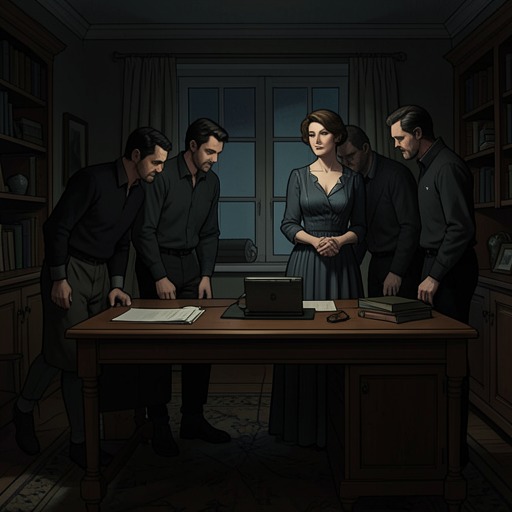
She does not disclose the document in private or delegate its reading. After an hour among her guests, she leaves the group by the fireplace, goes to her desk, and uses a glass paperweight to bring the conversation to a halt. She opens her briefcase, lays out the papers, and deliberately takes her time before beginning. Jonathan Ainsley fetches her a glass of water; Emma sips it while the four conspirators wait. Her measured handling of the papers controls the room before the contents are known. By announcing the will herself, she makes the act of succession inseparable from her own authority.
The McGill inheritance
Before discussing her own holdings, Emma corrects what she calls a misunderstanding about the McGill empire. Paul McGill’s will did not leave her unrestricted power to distribute his fortune. Under its terms, Daisy Ainsley Amory, Paul’s natural daughter, is to inherit the entire McGill estate when Emma dies. After Daisy’s death, it passes in equal shares to her children, Paula McGill Amory and Philip McGill Amory. Daisy is to receive the estate’s income during her lifetime, with the Rossiter Merchant Bank serving as trustee.
Emma assigns practical responsibilities to match that inheritance structure. She names Daisy executrix of the McGill estate, with Henry Rossiter as co-executor. On Emma’s death, Paula is to take Emma’s place on the board of Sitex Oil Corporation of America and act for her mother; Emma has trained her for that role. Philip, whom Emma has also supervised for three years, is to take control of the McGill holdings in Australia and run them for Daisy. Emma makes explicit that her other children and grandchildren cannot inherit from this estate. These provisions preserve the line of succession established by Paul rather than treating his fortune as part of Emma’s freely disposable property.
The separation also reflects the history of the family’s legal identities. Emma had concealed the identity of Edwina’s father, and when Blackie O’Neill pointed out that the registrar required a father’s name on a birth certificate, he offered to put his own name there. Years later, Emma told Joe Lowther that Edwina was illegitimate but again withheld the father’s identity. The will’s precision about Paul’s natural daughter and the limits on who may inherit the McGill fortune stands in sharp contrast to the secrecy that shaped Edwina’s place in the family.
Harte Enterprises and the chosen successor
Emma then turns to Harte Enterprises, the holding company she owns outright. It controls her clothing factories and woollen mills, Deerfield Estates, the Roe Land Development Corporation, the General Retail Trading Company, and the Yorkshire Consolidated Newspaper Company. She describes it as worth many millions of pounds. For this company, she sets out a different arrangement from the one governing the McGill estate: she decides who will hold the shares and, above all, who will control the enterprise.
She bequeaths 52 per cent of her Harte Enterprises shares to her grandson Alexander Barkstone. The remaining shares go to Sarah Lowther, Jonathan Ainsley, and Emily Barkstone, divided equally among them; Emma specifies that each is to receive 16 per cent of the shares. She calls Alexander the person best equipped, through knowledge and experience, to run the company and places control in his hands to prevent later dissension. The other three beneficiaries are to continue working in the subsidiaries and take charge of their own divisions after her death. Emma also establishes a trust of one million pounds for each of the four grandchildren, Alexander included. She presents unequal control not as a judgment that the others lack ability, but as a means of securing a single decision-making centre while providing each beneficiary with a substantial interest and income.
The announcement exposes the gap between the family’s expectations and Emma’s plan. Kit gasps; Robin turns pale and begins to rise when he hears Alexander’s bequest. Emma continues, then explains that the arrangement is intended to preserve the company, not to slight the other beneficiaries. Her allocation makes continuity the stated test of succession: the person who will direct the enterprise is selected for preparation and experience, while the others retain defined roles and financial provision.
Harte Stores and the confrontation
Emma treats the Harte department-store chain as a distinct legacy. She recalls building it from nothing through a lifetime of work and describes it as one of the largest chains in the world. She gives all her shares in Harte Stores to her granddaughter Paula McGill Amory, along with the remainder of her emerald collection. Paula rises unsteadily but thanks Emma for the trust and promises to keep the stores safe. The bequest places a major enterprise in the hands of someone Emma has chosen to continue her work.
Emma also appoints Daisy executrix of her own estate, with Henry Rossiter as co-executor. Robin responds by accusing her of unfairness and claiming that her children are her legal heirs. He threatens to contest the will, alleging undue influence and incompetence. Emma answers that she has deliberately excluded him, Kit, Edwina, and Elizabeth because they plotted to take her empire, even at the expense of their own children. She says they underestimated her, and explains that the trusts she had established for them years earlier will remain in place despite their conduct.
The will’s provisions are backed by a further settlement intended to prevent a court challenge from disrupting the businesses. Emma produces four cheques, each for one million pounds, and makes clear that they are not unconditional gifts. Each child must sign an individual contract agreeing not to contest the will; she tells Robin that accepting the money as consideration makes such a challenge unavailable to him. She says the will is irrevocable and describes the payments as protection against disturbance of her commercial empire and harm to her grandchildren. Elizabeth signs first; Edwina and Robin follow, and Kit signs last, his hand shaking. All four accept the cheques and sign the contracts.
Once the documents are secured in her briefcase, Emma declares the family business completed and proposes returning to the party. The ensuing uproar does not undo the settlement: the legal terms, the cheques, and the signatures have made her response concrete. The will thus functions not simply as a record of what Emma owns, but as a means of controlling how power passes, limiting the scope of dispute, and safeguarding the next generation from the ambitions that have fractured her own household.